
This article is part of Acuity Institute’s Improvement Leadership Insights series, where we explore the leadership skills that help project managers, Lean Six Sigma practitioners, change leaders, and continuous improvement professionals successfully lead organizational improvement.
For many project leaders, communication is surprisingly uncomfortable. They know they should keep stakeholders informed, but they’re unsure what to say, how much to share, or how people will react.
So, they do what many of us naturally do when conversations feel difficult. They send an email.
Emails rarely build commitment.
People don’t support change because they received another project update. They support change because they understand the purpose of the project, feel that their concerns have been heard, and trust the people leading the effort.
Communication Is About Building Relationships—Not Broadcasting Information
One of the biggest misconceptions about stakeholder communication is that success is measured by how much information is distributed. It isn’t.
Communication is successful when it creates understanding, builds trust, and encourages dialogue. That means communication should be designed to generate conversations—not simply deliver updates.
The 80 Percent Rule
Experienced change leaders often follow a simple principle:
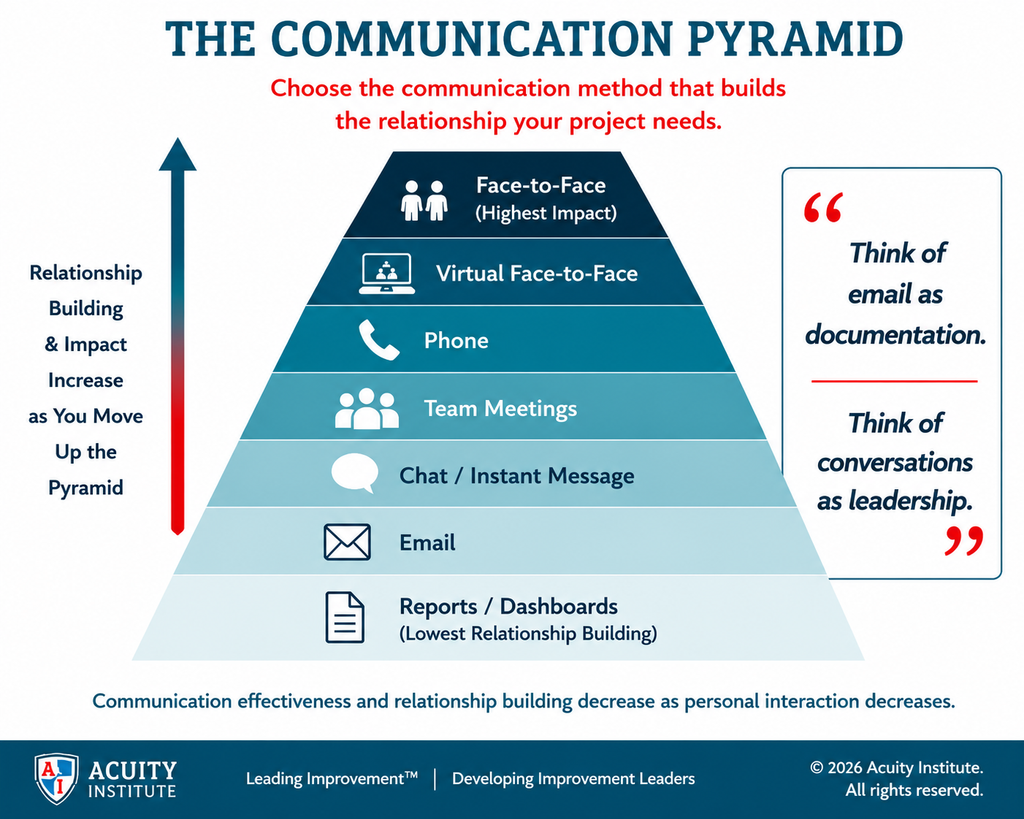
Approximately 80% of stakeholder communication should occur face-to-face whenever possible, and it should be in-person whenever possible.
While in-person is the most effective, the workplace environment has shifted dramatically, and virtual face-to-face meetings may be your best option. If using virtual meetings, be sure that you and your attendees use your cameras.
Face-to-face conversations create opportunities to:
- Observe body language.
- Clarify misunderstandings immediately.
- Ask follow-up questions.
- Listen to concerns.
- Build trust.
Email, dashboards, newsletters, and project reports still have value—but they work best when supporting relationships, not replacing them.
Think of email as documentation. Think of conversations as leadership.
Replace Updates With Dialogue
Instead of asking:
“Does anyone have any questions?”
Try asking:
- What concerns do you have about this change?
- What challenges do you anticipate?
- What would make implementation easier?
- What haven’t we considered yet?
- What would success look like from your perspective?
These questions invite participation instead of passive agreement.
Use an Elevator Speech
An elevator speech isn’t a sales pitch. It’s a simple, consistent explanation that helps stakeholders understand what you’re trying to accomplish and why it matters. Every Lean Six Sigma project leader should be able to explain the project in about 30 seconds.
An example:
“We’re looking at how customer orders are received because we’ve identified delays that affect both our customers and our internal teams. Right now, we’re gathering information and talking with employees to understand the process before recommending any changes.”
Simple.
Clear.
No jargon.
No assumptions.
The message stays consistent regardless of who asks.
Choose Your Words Carefully
The words project leaders choose can either encourage collaboration or create defensiveness.
Instead of saying: “The problem is how frontline employees are entering their customer orders.”
Try: “We’ve identified an opportunity to improve how customer orders are initially received so we can reduce delays and improve consistency.”
The second statement focuses on the process rather than assigning blame. Lean Six Sigma improves systems—not people.
Avoid Solving Problems Too Early
An elevator speech is especially helpful in the early stages of an improvement project. When speaking with stakeholders, remember that they are used to problem/solution thinking.
Problem/solution thinking assumes that if we are discussing a problem, we are also looking for someone to offer the right solution. Improvement projects use a different approach to problem-solving. Instead of seeing the problem simply as something that needs a solution, we look to define and understand the process that is producing the problem and how the process can be improved. That’s Process/Process Improvement thinking.
It can be difficult to manage stakeholder conversations when the conversation they want to have is problem/solution thinking.
Someone offers an idea.
The project leader immediately agrees.
Or immediately disagrees.
Instead, acknowledge the input without committing to a solution.
For example:
“I really appreciate your insight, and I’ll be sharing it with the team. Right now, we’re still analyzing the data to ensure we understand the critical root causes before identifying solutions.”
This response accomplishes several things:
- It validates the stakeholder.
- It keeps the conversation positive.
- It protects the integrity of the DMAIC process.
- It avoids creating expectations that may later need to change.
Create Shoulder-to-Shoulder Conversations
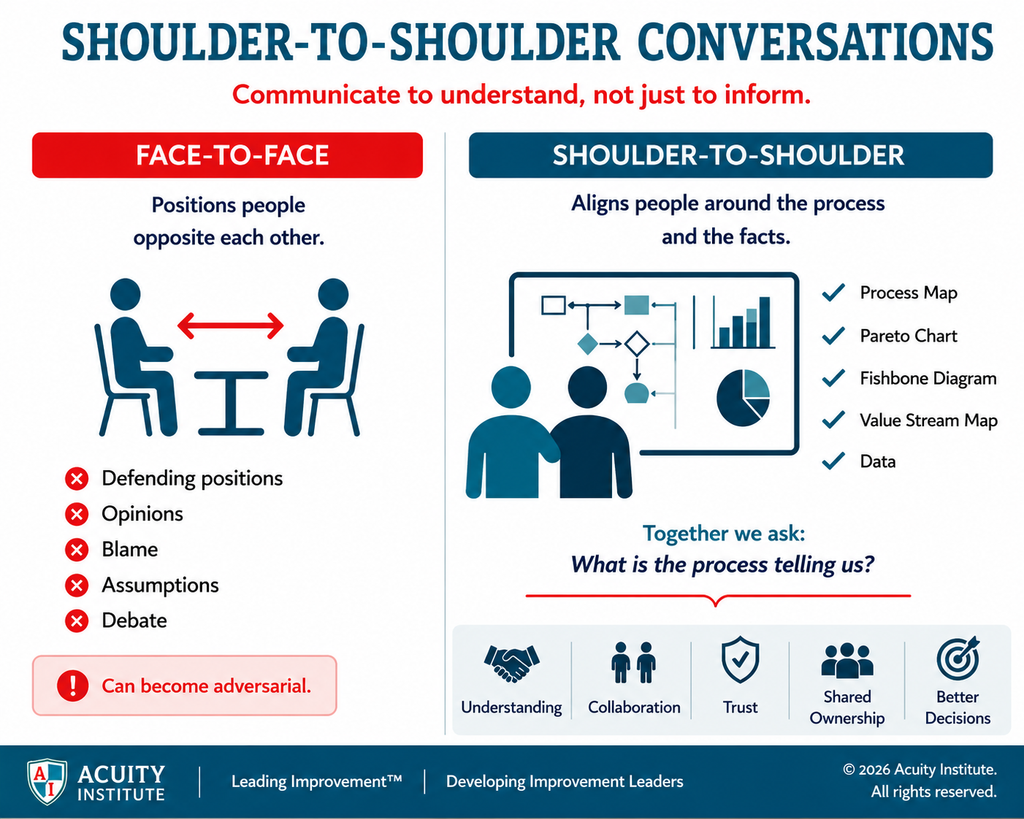
One of the visuals I use in my coaching is to encourage shoulder-to-shoulder conversations. Imagine that you and a stakeholder are not on the same page about what the problem truly is. Sitting across from each other you are face-to-face, each holding their position and these conversations can be challenging. Instead, use your tools to change the dynamics of the conversation.
For example, reviewing the process map helps everyone see the process together. Everyone is now shoulder-to-shoulder, evaluating the analysis and understanding the process. The conversations shift from:
“You versus me”
To
“Let’s understand the process and improve it together”
Communication Doesn’t End After The Meeting
Stakeholder communication should continue throughout every phase of DMAIC. Some conversations will occur one-on-one. Others may happen during team meetings, Gemba walks, project reviews, workshops, or informal discussions in the workplace.
The goal isn’t simply to communicate more often.
It’s to communicate in ways that build understanding, trust, and commitment.
Looking for more communication training?
Preparation is Critical
Great stakeholder conversations rarely happen by accident. Like any important presentation or negotiation, they require preparation and practice.
- Prepare an elevator speech to begin each conversation.
- Anticipate the questions, concerns, problem/solution thinking that could come up in the meeting and prepare your responses.
- Be prepared to respond to:
- Premature solutions or root causes that are not yet vetted
- Finger-pointing or blaming
- What tools could you be ready to share that will help facilitate shoulder-to-shoulder conversation?
- How can you promote feedback?
- What questions will help keep the dialogue open?
Final Thoughts
People don’t remember every project update.
They remember how project leaders made them feel.
- Did they feel heard?
- Did they feel respected?
- Did they understand why the change mattered?
Successful Improvement Leaders know that every conversation is an opportunity to strengthen trust—and trust is the foundation of lasting improvement.
Communicate to understand, not just to inform.
Acuity has developed the Improvement Leadership Resource Library to help you prepare for important conversations before they happen.
The Leadership Conversation Checklist is just one of the many resources available in the Resource Library.
Download a free copy of the checklist and start preparing for your next meeting.
Leadership Challenge
This week, choose one stakeholder conversation you’ve been postponing because an email feels easier.
Before the conversation:
- Prepare a 30-second elevator speech.
- Write down three open-ended questions that encourage dialogue.
- Identify one process improvement tool you can use to create a shoulder-to-shoulder conversation.
After the meeting, ask yourself: Did I spend more time presenting information—or building understanding?
Leadership Reflection
Before your next improvement meeting, ask yourself:
“Am I preparing to deliver information—or to build understanding?”
The answer may change not only the conversation, but also the relationship.
Next in the Leadership Series: Resistance Isn’t the Problem—It’s a Signal