This article is part of Acuity Institute’s Improvement Leadership Insights series, where we explore the leadership skills that help project managers, Lean Six Sigma practitioners, change leaders, and continuous improvement professionals successfully lead organizational improvement.
Too often, the analysis is solid. The root causes are validated. The solution is proven. The financial benefits are compelling. Yet the project struggles—or even fails—not because the technical solution was wrong, but because the people affected by the change were never fully engaged.
Lean Six Sigma is about improving processes, but lasting improvement depends on people embracing the change. Even the most well-designed solution can stall if stakeholders are not informed, involved, and committed throughout the project.
Start Early—Before Resistance Begins
Many teams don’t engage stakeholders until they need approval or are ready to implement changes. Others secure early support and assume that support remains unchanged throughout the project.
In reality, change is constant. Priorities shift. Organizational changes occur. New concerns emerge. Stakeholders who initially supported the project may become hesitant if they feel disconnected or uninformed.
Stakeholder management should begin during the Define phase. Ask questions such as:
- Who will be affected by this project?
- Who has the authority to influence project decisions?
- Who could become a champion—or a barrier—to success?
- Who will need additional support during implementation?
Early engagement helps project leaders understand expectations, identify hidden risks, build trust, and create advocates before resistance develops.
Not All Stakeholders Require the Same Level of Attention
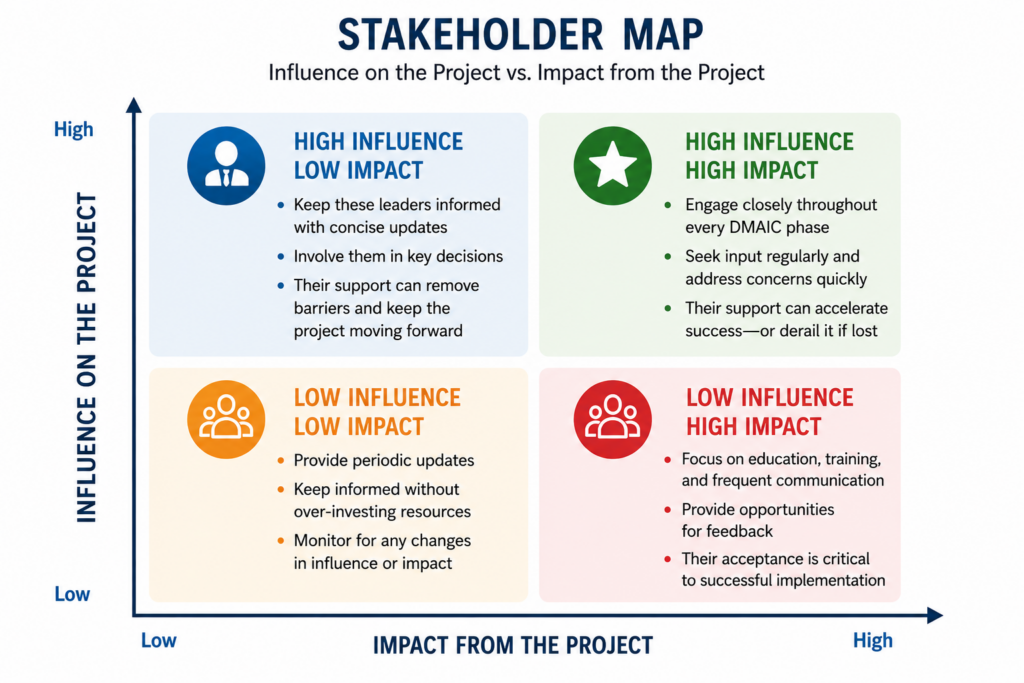
Every project has numerous stakeholders, but they should not all receive the same communication strategy. It is not enough to identify the teams that will be impacted by the project. Look within those teams to identify the individuals and smaller groups that should be managed differently, based on their influence on the project and the impact the project will have on them.
One of the most valuable planning tools is a stakeholder map. It helps project leaders determine where to focus communication and engagement efforts by evaluating stakeholders according to their influence on the project and the impact the project will have on them.
An Ever-Changing Landscape
Remember: Stakeholder maps are not static. As projects evolve, influence, priorities, and stakeholder attitudes often change. Review and update your stakeholder assessment regularly to ensure your communication strategy remains effective.
Communication Should Be Continuous
Stakeholder communication is not a one-time activity. It should begin during the Define phase and continue through every phase of DMAIC.
Successful Lean Six Sigma projects communicate consistently throughout every phase of DMAIC.
Effective updates answer questions such as:
- What progress has been made?
- What decisions have been reached?
- What challenges have emerged?
- What risks are being monitored?
- What happens next?
- How will these changes affect stakeholders?
Consistent communication reduces uncertainty, builds confidence, and prevents rumors from filling information gaps.
Communication Must Be Two-Way
One of the biggest mistakes project teams make is treating communication as a one-way broadcast.
Great project leaders spend as much time listening as they do presenting.
Ask stakeholders:
- What concerns do you have?
- What obstacles do you anticipate?
- What opportunities are we missing?
- What would make implementation easier?
- What support do you need?
Stakeholders possess valuable operational knowledge that can strengthen solutions, identify risks early, and improve implementation plans. When people feel heard, they are far more likely to support the change.
Projects improve processes—but people sustain the improvement.
The Stakeholder Engagement Planner is just one of the many resources in Acuity’s new Improvement Leadership Resource Library.
Explore the Improvement Leadership Resource Library for practical planners, templates, and leadership tools designed to help you prepare for stakeholder conversations, strengthen relationships, and lead meaningful improvement with confidence.
Leadership Coaching Moment
Situation
A department manager says:
“I don’t see why my team needs to be involved yet.”
Instead of saying
“Because we need your support.”
Try saying
“Your team’s perspective is important because they’re closest to the process. We’d like to understand their experience before we begin evaluating solutions.”
Why this works
- Invites collaboration.
- Avoids creating defensiveness.
- Reinforces process thinking.
- Builds trust before implementation.
Leadership Challenge
Review your current stakeholder list.
Ask yourself:
- Have I identified the people most affected by this project?
- Am I communicating differently, based on their influence and impact?
- When was my last two-way conversation with each key stakeholder?
Choose one stakeholder this week and schedule a conversation focused on listening rather than providing an update.
Leadership Reflection
Ask yourself:
“Who haven’t I talked to lately that could influence the success of this project?”
Sometimes the most important conversation is the one we haven’t had yet
Did You Miss Part One?
Read Great Analysis Doesn’t Guarantee Great Results to learn why stakeholder management is one of the most overlooked drivers of Lean Six Sigma success.