
Why Great Improvement Leaders Know Where to Focus
This article is part of Acuity Institute’s Improvement Leadership Insights series, where we explore the leadership skills that help project managers, Lean Six Sigma practitioners, change leaders, and continuous improvement professionals successfully lead organizational improvement.
One of the things I admire most about project leaders is their desire to make a meaningful impact. When given the opportunity to improve a process, they don’t think small—they think about how they can transform an entire value stream.
Unfortunately, that’s also one of the most common reasons improvement projects struggle.
One of the first questions I ask a project leader is:
“Can you describe your project scope in one to two sentences?”
If that question is difficult to answer— If the answer requires a lengthy explanation—or spans multiple departments, systems, and competing priorities — it’s often the first sign that your project scope needs refinement. One of the most valuable coaching conversations I have is helping teams distinguish between the value stream they are wanting to improve and the project’s scope.
One of the most valuable coaching conversations I have is helping teams distinguish between the value stream they are wanting to improve and the project’s scope.
It begins with the best intentions. Project leaders naturally want to make the biggest possible impact.
They want to solve the entire problem.
Senior Leaders naturally communicate ambitious goals because they are focused on the organization’s long-term success. The challenge for project leaders is translating those strategic objectives into focused, achievable improvement projects.
Unfortunately, enthusiasm can quickly create projects that become too large to manage.
Before long, a single project spans:
- Multiple departments
- Numerous stakeholders
- Several technology systems
- Multiple process maps
- Competing priorities
- Dozens of improvement opportunities
As project scope expands, complexity increases.
Decision-making slows.
Resources become stretched.
Implementation takes longer.
Momentum begins to fade.
Ironically, projects intended to create the greatest impact often struggle to deliver meaningful results because they attempt to improve too much at once.
Strategic Objectives vs. Project Scope
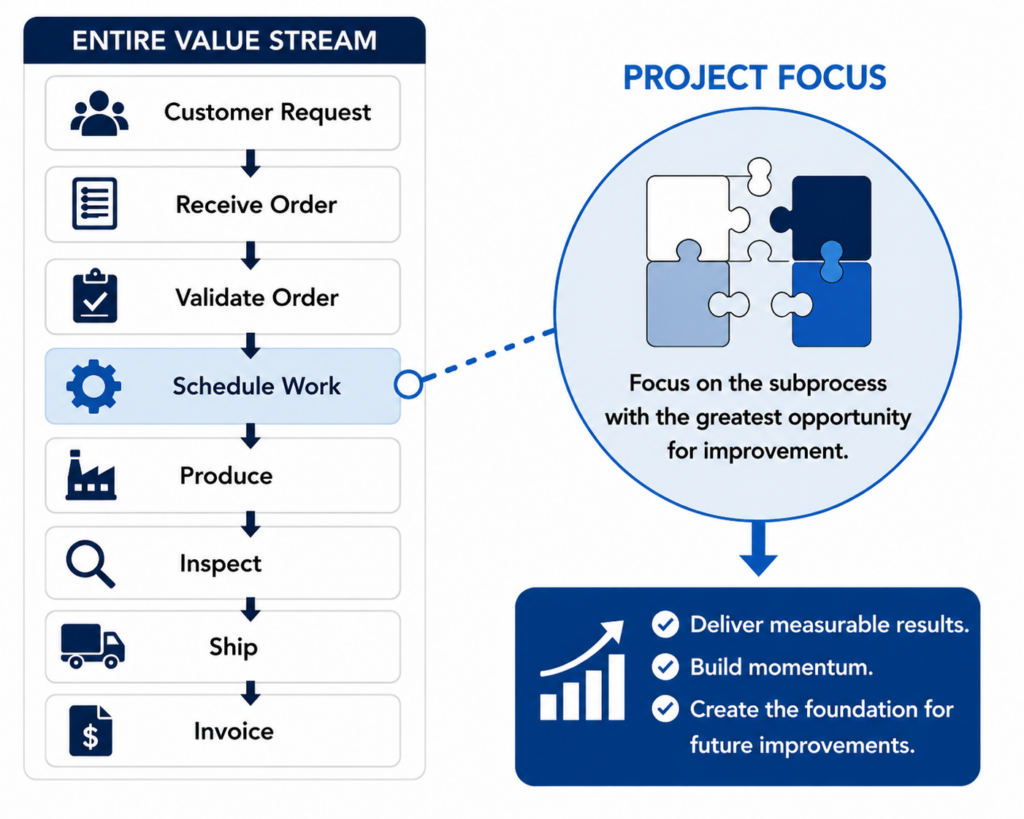
Leaders think in terms of improving value streams. A value stream is the end-to-end sequence of activities an organization undertakes to deliver a product or service to the customer. Aligning the company’s strategic objectives to the value stream ensures that every dollar, resource, and workflow actively drives the company’s ultimate mission.
That’s how organizations achieve transformation.
But project leaders succeed by translating those strategic objectives into focused, achievable projects.
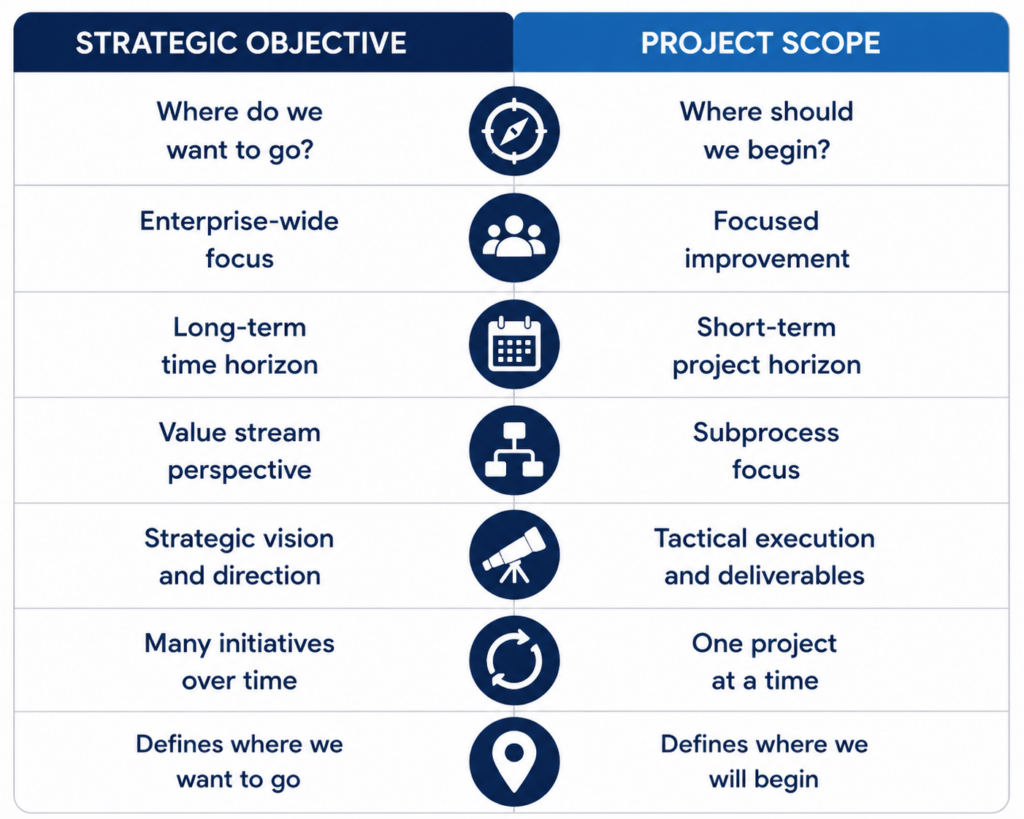
A strategic objective answers:
Where do we want to go?
A project scope answers:
Where should we begin?
See the whole. Improve a part.
Great Improvement Leaders understand the entire value stream—but they know lasting results come from focusing on one well-defined improvement opportunity at a time.
They:
✔ Understand how the entire value stream works.
✔ Identify the subprocess with the greatest opportunity for improvement.
✔ Define a project that is achievable and measurable.
✔ Deliver meaningful results.
✔ Build momentum for future improvements.
Organizations improve value streams. Projects improve subprocesses. Great leaders know the difference.
Those are not the same thing.
A well-scoped project focuses on one meaningful improvement opportunity within the larger value stream.
Delivering measurable success in one subprocess creates momentum, builds organizational confidence, and often opens the door for future improvement initiatives throughout the rest of the value stream. The goal isn’t to complete one massive project. The goal is to create a series of successful improvement initiatives that collectively transform the value stream.
Leadership Is About Focus
One of the most valuable leadership skills is resisting the temptation to solve everything at once.
Experienced Improvement Leaders maintain two perspectives simultaneously.
They keep the organization’s strategic objectives in view while ensuring each project has a clearly defined, achievable scope.
They understand that sustainable transformation is rarely accomplished through one massive initiative.
It is achieved through a series of successful improvement projects that build upon one another over time.
Every successful transformation begins with one focused improvement project.
See the whole. Improve a part.
Explore the Improvement Leadership Resource Library for practical planners, templates, and leadership tools designed to help you prepare for stakeholder conversations, strengthen relationships, and lead meaningful improvement with confidence.
Leadership Coaching Moment
Situation
An executive sponsor says:
“I’d like this project to improve the order-to-fulfillment process.”
“We’ll do our best.”
“That’s exactly the outcome we’re working toward. To achieve it successfully, we’d like to first identify the subprocess that presents the greatest opportunity. Delivering measurable improvements there will build momentum and create a strong foundation for improving the rest of the value stream.”
Why this works:
- Aligns with leadership’s strategic vision.
- Demonstrates disciplined project leadership.
- Sets realistic expectations.
- Increases the likelihood of meaningful, sustainable results.
Leadership Challenge
Review your current project charter.
Ask yourself:
- Have I clearly distinguished between our strategic objective and my project’s scope?
- Am I trying to improve an entire value stream—or to solve the highest-impact problem within it?
- Can I clearly describe my project scope in one to two sentences?
- Does my project focus on a specific subprocess?
If your scope continues to expand every time a new opportunity is identified, your project may be trying to solve too much.
Leadership Reflection
Before approving your next project charter, ask yourself: “Am I trying to improve an entire value stream—or am I focusing my team on the improvement opportunity where they can create the greatest impact?”
Great Improvement Leaders see the whole system.
Exceptional Improvement Leaders know where to begin.
Continue the Journey
Coming next in the Improvement Leadership Insights series – Stakeholder Management: The Hidden Key to Project Success
Once you’ve defined the right project, your next leadership responsibility is engaging the people who will determine whether that project succeeds.