
How great improvement leaders uncover the real reasons people resist change.
This article is part of Acuity Institute’s Improvement Leadership Insights, where we explore the leadership skills that help project managers, Lean Six Sigma practitioners, change leaders, and continuous improvement professionals successfully lead organizational improvement.
Whether you’re implementing a new process, introducing new technology, or asking people to work differently, resistance is almost inevitable.
But over the years, I’ve come to appreciate resistance.
Instead of feeling frustrated or offended by it, I now look for it. It indicates that the project is having an impact. Instead of asking how to overcome resistance, the better question to ask is:
What is the resistance trying to tell us?
The answer often reveals more about our improvement effort than it does about the people resisting it.
Resistance Is Information
When a project begins encountering resistance, it’s easy to assume people simply don’t want to change.
Sometimes that’s true.
More often, however, resistance is a symptom of something deeper.
- People may be uncertain about what’s changing.
- They may not understand why the change is necessary.
- They may worry about their ability to succeed.
- They may have experienced previous improvement initiatives that promised more than they delivered.
- Or they may see risks the project team hasn’t yet recognized.
In each of these situations, resistance isn’t the problem.
It’s valuable information.
As improvement leaders, our responsibility isn’t simply to reduce resistance. Our responsibility is to understand it.
Curiosity Changes the Conversation
One of the greatest leadership skills you can develop is replacing assumptions with curiosity.
When someone pushes back, ask yourself:
“What might this person know that I don’t?”
That simple question changes the entire conversation.
Instead of viewing resistance as opposition, you begin viewing it as feedback.
Sometimes that feedback identifies legitimate concerns.
Sometimes it reveals communication gaps.
Sometimes it uncovers training needs.
And sometimes it reminds us that people need time to process change before they can fully support it.
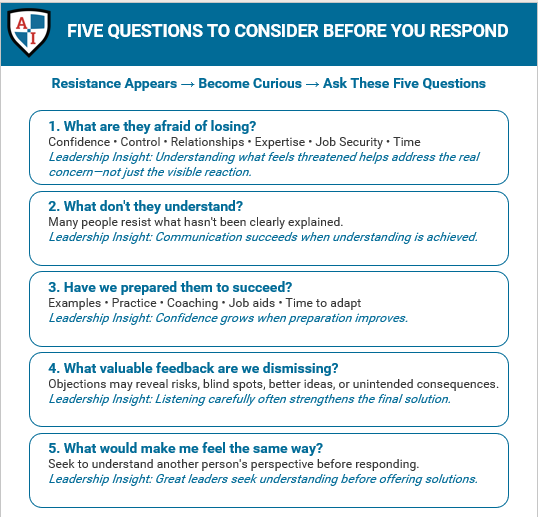
Respond Before You React
When resistance appears, resist the temptation to immediately defend your project.
Instead:
Pause.
Listen.
Ask questions.
Seek to understand.
Only then decide how to respond. The quality of your response will almost always improve when it’s based on understanding rather than assumption.
Leadership Isn’t About Winning the Argument
One of the biggest misconceptions about change leadership is believing success comes from convincing everyone to agree.
In reality, leadership isn’t about winning arguments.
It’s about building understanding.
When people feel heard, respected, and included, resistance often begins to soften naturally.
Not because they lost the debate.
Because they joined the journey — so now, change is happening with them rather than happening to them.
The Resistance Analysis Planner is one of the many resources available in the Resource Library.
Leadership Takeaway
One of my favorite reminders is this:
People rarely resist change because they enjoy saying “no.” They resist because something important to them feels uncertain, threatened, or misunderstood.
As improvement leaders, our job isn’t to eliminate resistance.
Our job is to understand it, learn from it, and lead people through it.
Sometimes the greatest breakthrough in an improvement project begins with one thoughtful question instead of one persuasive answer.
Leadership Reflection
The next time someone disagrees with one of your ideas…
Don’t defend it immediately.
Ask one question first:
“Can you help me understand what’s driving your concern?”
Then simply listen.
You may discover that the resistance is helping improve your solution rather than preventing it.
Next in the Series: Influence with Authority
Related Articles: Change Management A Key To Project Success, System Factors for Managing Resistance to Change