
This is the first article in Acuity Institute’s new Improvement Leadership Insights series, where we explore the leadership skills that help project managers, Lean Six Sigma practitioners, change leaders, and continuous improvement professionals successfully lead organizational improvement.
Lean Six Sigma provides a disciplined, data-driven approach for solving business problems. It helps organizations eliminate waste, reduce variation, improve quality, and deliver measurable financial results.
But, while Lean Six Sigma improves processes, it doesn’t automatically change behaviors.
Every improvement project introduces change. New processes are adopted. Responsibilities shift. Long-standing habits are challenged. Some employees welcome the improvements, while others worry about increased workloads, changing expectations, or losing familiar ways of working.
Technical excellence alone cannot overcome the human side of change.
The most successful project leaders recognize that project success depends on more than identifying the right solution—it depends on helping people successfully adopt that solution.
Every Stakeholder Experiences Change Differently
One of the biggest mistakes project teams make is assuming that everyone experiences change in the same way.
Consider a typical Lean Six Sigma project:
- Executive sponsors may be focused on financial performance and strategic objectives.
- Department managers may be concerned about resources, productivity, and meeting operational goals.
- Supervisors may worry about training employees while maintaining daily performance.
- Frontline employees may simply want to understand how the new process will affect their jobs.
Each group views the project through a different lens.
When project leaders recognize these different perspectives, they can address concerns before they become resistance.
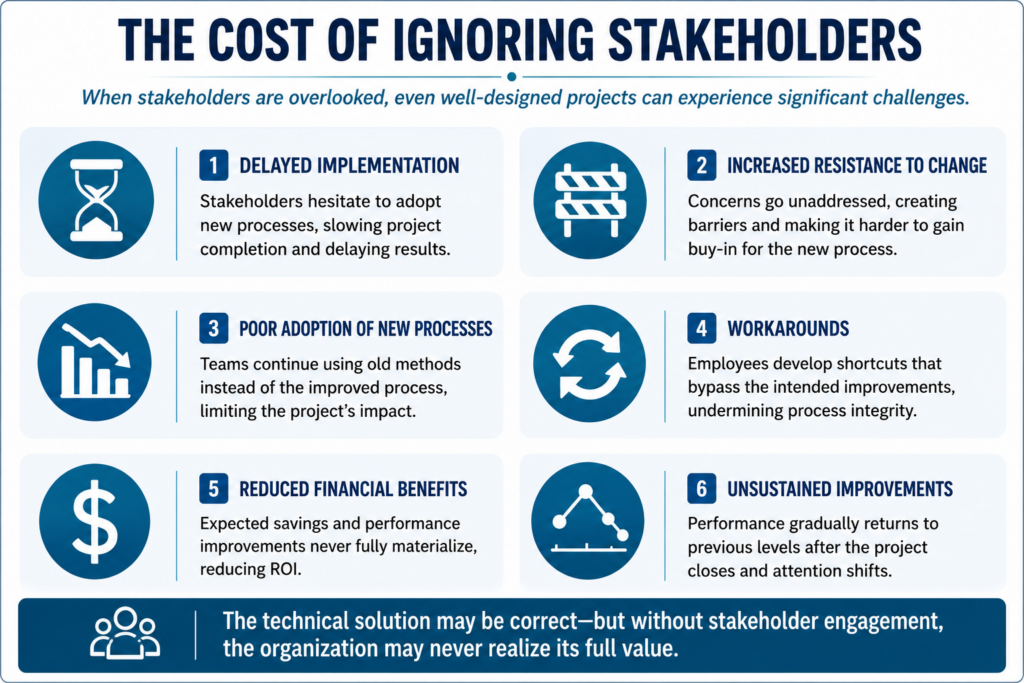
When project teams fail to recognize these different perspectives, the consequences can be significant. Even technically sound Lean Six Sigma projects can struggle to achieve lasting results.
Stakeholder Management Is a Leadership Skill
One of the defining characteristics of exceptional Lean Six Sigma leaders is their ability to lead people through change—not just improve processes.
They understand that successful projects require communication, collaboration, and trust throughout the project lifecycle.
Rather than waiting for resistance to appear, they engage stakeholders early, encourage feedback, and build support before implementation begins.
They recognize that every conversation is an opportunity to strengthen commitment to the project.
Leadership Coaching Moment
Situation
A project sponsor says: “We’ve already identified the solution. Let’s move ahead.”
Instead of saying
“Okay.”
Try saying
“I appreciate everyone’s enthusiasm. Before we commit to a solution, I’d like to ensure we’ve fully validated the root causes so we can implement improvements that deliver lasting results.”
Why this works:
- Reinforces DMAIC thinking.
- Builds confidence in the process.
- Prevents premature solutions.
- Demonstrates leadership rather than simply project management.
Leadership Challenge
This week…
Identify one stakeholder who will be affected by your current or next improvement initiative.
Instead of asking yourself, “How will this project impact them?”
Ask, “What concerns, motivations, or opportunities might they see that I haven’t considered?”
Write down three insights before your next project meeting.
Leadership begins with curiosity.
Leadership Reflection
Before your next improvement meeting, ask yourself:
“Am I spending as much time leading people as I am analyzing processes?”
The most successful improvement leaders recognize that sustainable results require both technical excellence and effective leadership.
Looking Ahead
Recognizing the importance of stakeholder management is only the beginning.
The next challenge is understanding who to engage, when to engage them, and how to tailor communication throughout the project.
Next month, learn how to identify, prioritize, and engage stakeholders throughout your improvement initiatives.
Want to become a more effective Improvement leader?
We have developed the new Improvement Leadership Resource Library. Every resource is designed to help you move from understanding leadership concepts to applying them in real projects.
Throughout this Improvement Leadership Series, we will be introducing you to some of the templates, planners and leadership tools that are included in the resource library. The Improvement Leadership Resource Library is available starting today, with tools such as:
- Stakeholder Engagement Planner
- Resistance Analysis Planner
- Leadership Conversation Checklist
- Communication Frameworks
- Difficult Conversation Planner
- Elevator Speech Builder
- Live Virtual Sessions with Acuity Master Black Belts, and more!
We’re adding new resources regularly, so your library will continue to grow.